

The global economy is shifting, and for American businesses looking to grow, the compass points East. India has transformed from a simple outsourcing hub into one of the world’s most dynamic consumer markets. With a population of over 1.4 billion and a government actively encouraging foreign investment, the opportunity for business setup in India for USA companies has never been more attractive.
Whether you are a tech startup in Silicon Valley or a manufacturing giant in the Midwest, entering the Indian market offers a unique blend of scale, talent, and innovation. However, navigating a foreign legal landscape can feel daunting. How do you choose the right entity? What are the rules?
This guide breaks down everything you need to know about establishing a presence in India. We will walk you through the structures, the benefits, and the exact steps to get your Indian operations up and running smoothly.
Why Choose India? Strategic Advantages for US Companies
Before diving into the paperwork, it is important to understand the value proposition. Why are so many US companies rushing to register in India? It goes beyond just cost savings.
Access to a Massive Consumer Base
India is not just a place to hire talent; it is a place to sell products. The country boasts a rapidly growing middle class with increasing disposable income. By setting up a local entity, you gain direct access to one of the largest consumer markets on the planet.
100% Foreign Ownership
One of the biggest incentives is the Foreign Direct Investment (FDI) policy. In many sectors—including manufacturing, software, and services—the Indian government allows 100% foreign ownership. This means your US parent company can retain complete control over operations, strategy, and profits without needing a local joint venture partner.
Skilled Workforce and Innovation
India produces millions of STEM graduates every year. The workforce is young, English-speaking, and highly skilled in technology, engineering, and management. Setting up a business here gives you access to this talent pool, allowing you to build high-performance teams that drive global innovation.
Strategic Location
India serves as an excellent gateway to the wider Asia-Pacific region. Its geographic location makes it a strategic hub for exports and servicing neighboring markets in the Middle East and Southeast Asia.
Choosing the Right Business Structure
The first major decision in the business setup in India for USA process is selecting the right legal structure. Your choice depends on your long-term goals. Are you here to test the waters, or are you here to stay and dominate?
1. Private Limited Company (Wholly Owned Subsidiary)
This is the most popular option for US businesses.
A Wholly Owned Subsidiary (WOS) operates as a Private Limited Company in India. The key feature here is that 100% of the shares are held by the foreign parent company (your US business).
- Why it works: It is treated as a domestic Indian company for all tax and regulatory purposes. It offers limited liability protection, meaning the US parent company is not directly liable for the debts of the Indian entity.
- Best for: Companies planning long-term operations, hiring staff, generating revenue, and manufacturing.
2. Limited Liability Partnership (LLP)
An LLP is a mix between a partnership and a company. It offers operational flexibility with fewer compliance requirements than a Private Limited Company.
- Why it works: It is easier to manage structurally. However, FDI in LLPs is allowed only under the “automatic route” in sectors where 100% FDI is permitted for companies.
- Best for: Professional services firms, consulting agencies, and small to medium-sized enterprises.
3. Branch Office / Liaison Office
If you aren’t ready for a full subsidiary, you can open an extension of your US office.
- Liaison Office: Strictly for communication. You cannot earn money or do business. You can only promote your US business and do market research.
- Branch Office: Allowed to conduct specific activities like export/import or consultancy, but manufacturing is generally restricted.
- Best for: Testing the market or maintaining a non-commercial presence.
Recommendation: For most US businesses, the Private Limited Company (Wholly Owned Subsidiary) is the gold standard. It offers the most freedom to operate and grow.
Eligibility Criteria for Registration
To proceed with a business setup in India for USA entities, you must meet specific legal requirements. The Indian Ministry of Corporate Affairs (MCA) has streamlined these rules, but they are strict.
Director Requirements
You need a minimum of two directors.
- At least one director must be a resident of India (someone who has stayed in India for at least 182 days in the previous financial year).
- The other director(s) can be US citizens or residents based in the US.
Shareholder Requirements
You need a minimum of two shareholders.
- For a Wholly Owned Subsidiary, the US company is the primary shareholder.
- To satisfy the legal requirement of “two” shareholders, a nominee (often a director) usually holds one share on behalf of the US company.
Registered Office
You must have a physical address in India. This cannot be a PO Box. It must be a verifiable location where official government mail can be received.
Step-by-Step Process: Business Setup in India for USA
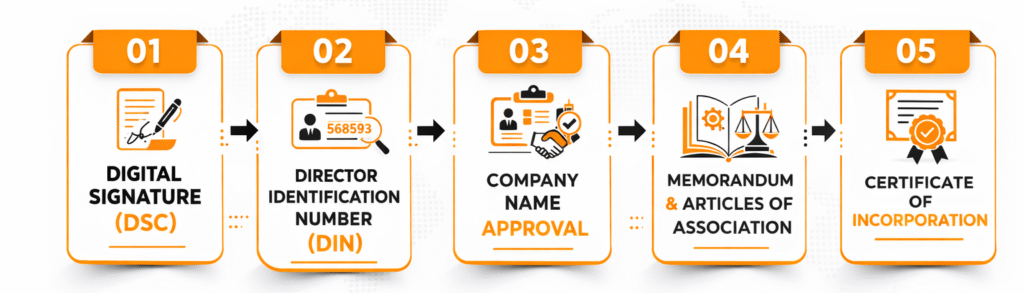
The registration process has become fully digital, making it faster and more transparent. Here is the roadmap to incorporation.
Step 1: Digital Signature Certificate (DSC)
Since the process is online, physical signatures don’t work. All proposed directors must obtain a Digital Signature Certificate. This is an encrypted digital key stored on a USB token, used to sign documents electronically.
Step 2: Director Identification Number (DIN)
Every director of an Indian company needs a unique identification number. You can apply for this during the incorporation filing, but it is a mandatory prerequisite for holding a directorship.
Step 3: Name Approval
You must choose a unique name for your Indian entity. If you are a subsidiary, you can usually use your US brand name followed by “India Private Limited.” The name must not conflict with existing Indian trademarks or companies.
Step 4: Filing the SPICe+ Form
This is the core of the registration. The SPICe+ (Simplified Proforma for Incorporating Company Electronically Plus) is a consolidated web form. It combines multiple applications into one:
- Name reservation
- Company incorporation
- DIN allotment
- PAN (Permanent Account Number) application
- TAN (Tax Deduction and Collection Account Number) application
Step 5: Drafting the MoA and AoA
You must draft the Memorandum of Association (MoA) and Articles of Association (AoA).
- MoA: Defines the company’s relationship with the outside world and states the main objectives (what business you will do).
- AoA: Defines the internal rules and regulations for management.
Step 6: Certificate of Incorporation
Once the Registrar of Companies (ROC) reviews and approves your SPICe+ form and documents, they will issue a Certificate of Incorporation (COI). This is your company’s birth certificate. It includes your Corporate Identity Number (CIN).
Essential Documents Checklist
Preparation is key. Having these documents ready will speed up your business setup in India for USA applications.
For the US Parent Company:
- Certificate of Incorporation of the US entity.
- Board Resolution from the US company authorizing the setup of the Indian subsidiary.
- Memorandum & Articles of Association of the US company (apostilled/notarized).
For Directors/Shareholders (US Nationals):
- Passport copies (apostilled in the US).
- Proof of address (Driver’s License, Utility Bill, or Bank Statement – apostilled).
- Passport-sized photographs.
For the Indian Resident Director:
- PAN Card (mandatory for Indian nationals).
- Aadhaar Card or Voter ID.
- Proof of address (Bank statement or utility bill).
For the Registered Office in India:
- Utility bill (electricity or gas) not older than two months.
- No Objection Certificate (NOC) from the property owner.
- Rent agreement or proof of ownership.
Post-Setup Essentials: Hitting the Ground Running
Receiving your Certificate of Incorporation is a major milestone, but it is not the finish line. To become fully operational, you must complete a few post-incorporation steps.
- Open a Bank Account: You will need to open a current account in an Indian bank. This is where you will deposit the initial share capital.
- FDI Reporting: Once the share capital is transferred from the US to India, you must report this foreign investment to the Reserve Bank of India (RBI) to ensure compliance.
- GST Registration: If you plan to sell goods or services, you must register for the Goods and Services Tax (GST). This allows you to generate compliant invoices.
- Shop and Establishment Act: Depending on which state your office is in, you may need to register under local labor